
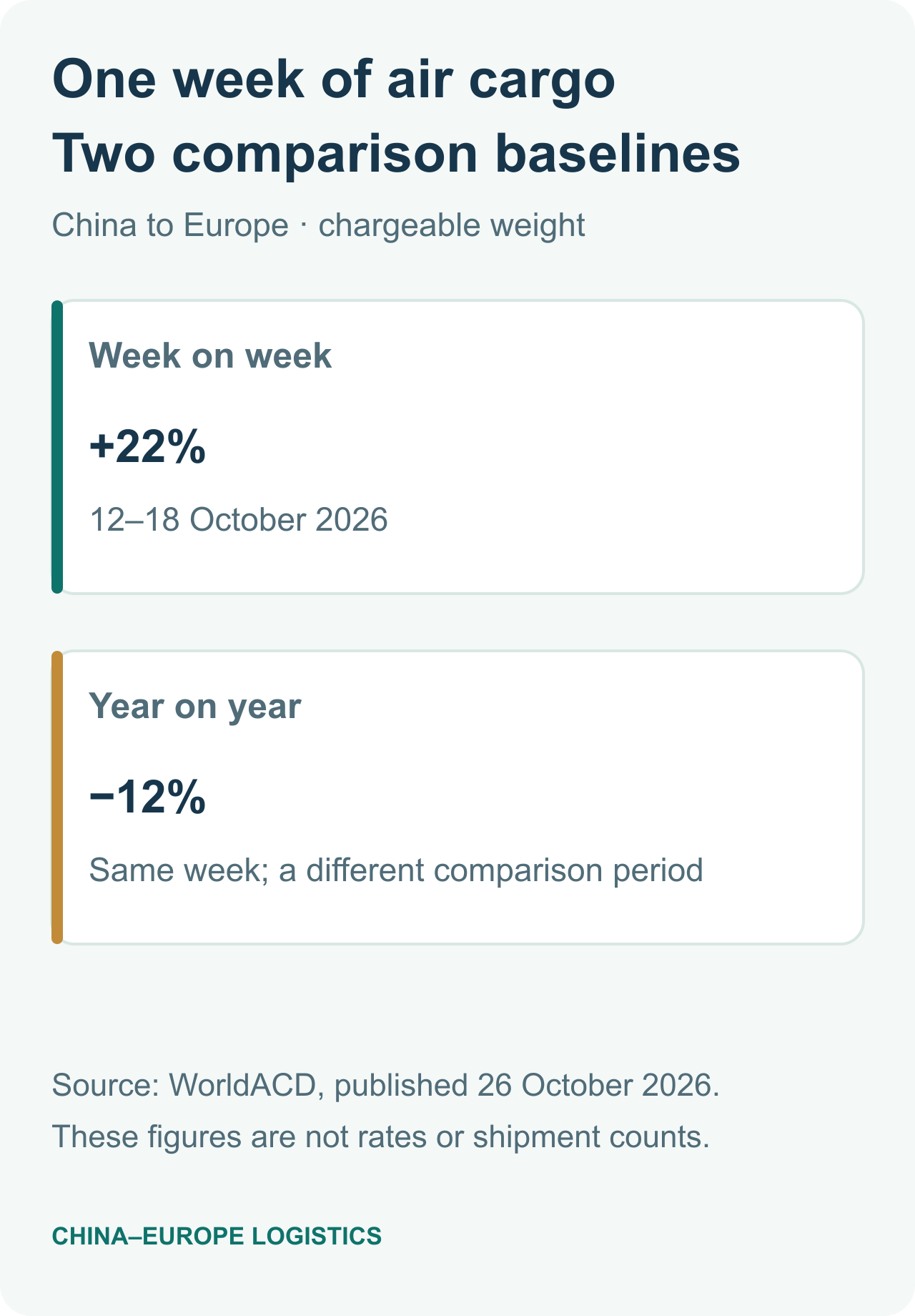
Air cargo on one trade lane can rise from the previous week while remaining below the level of a year earlier. In its week 42 air cargo report, published on 26 October 2026, WorldACD Market Data reported that chargeable weight from China to Europe increased 22% from the preceding week during 12–18 October, but fell 12% from the same period a year earlier.
The figures are not contradictory: one measures a short-term change, the other the gap against the previous year. The report links the recovery in Asian exports to factories restarting after the holiday, but one week’s rebound does not establish that a strong peak season has returned across all cargo types and European destinations. For businesses replenishing European inventory, a more useful approach is to distinguish resumed shipments from new orders and plan around the inventory and delivery requirements of each shipment.
What do +22% and −12% actually tell us?
Both comparisons concern the China-to-Europe air cargo chargeable weight covered by WorldACD. They are not counts of shipments, all European imports or all Chinese exports. The 22% week-on-week increase compares 12–18 October with the preceding week; the 12% year-on-year decrease compares it with the corresponding period a year earlier. The baselines differ: the percentages should not be added together, and the first does not mean demand grew 22% year on year.
The report was published on 26 October, but its measurement period was 12–18 October. It is a retrospective weekly report, not a live reading of cargo volumes on 26–28 October. WorldACD says Asian exports rebounded after the holiday; its public weekly report does not quantify, for each China–Europe cargo category or customer order, how much was delayed dispatch and how much was new demand.
The wider regional figures need their own labels. WorldACD reported that Asia Pacific-to-Europe cargo volume rose 13% week on week in the same period, while the rate for that regional trade lane rose 1%. Asia Pacific-to-Europe is broader than China-to-Europe, and a regional rate movement is not a shipment-specific quotation from a Chinese origin airport. Neither percentage should be relabelled as the China–Europe volume or rate change, and a 22% volume increase cannot be used to calculate the cost of a particular shipment.
How can shippers distinguish a post-holiday rebound from peak-season demand?
Higher volumes after a holiday may reflect the dispatch of goods already prepared or delayed, as well as new purchases. More order information and several weeks of data would be needed to establish the mix. The year-on-year decline shows that the weekly rebound had not closed the gap with the same period last year; it does not, on its own, prove that the following weeks will be weak.
As a planning exercise, businesses can track several signals together: whether customers have confirmed quantities and receiving windows, whether factories can deliver as scheduled, which SKUs may face inventory gaps in Europe, and whether an appropriate airport, flight or connecting service can be confirmed. Treating enquiries or sales forecasts as firm orders can lead to stock and transport plans that do not match actual demand.
Equally, a single market report cannot describe every European destination airport, commodity or carrier service. Cargo dimensions, receiving dates and customs requirements differ, so the options available for individual shipments may differ too.
Identify the cargo that really needs air freight, then assess split shipments
For orders with tight inventory or a defined project deadline, start by identifying the shortfall by SKU and delivery window instead of automatically moving the whole order by air. If certain components affect production, or certain goods are needed for a near-term confirmed customer delivery, first check whether that portion can be packaged, declared, received and used independently. The remainder can then be compared with executable ocean or rail options.
Splitting a shipment does not automatically save money. Additional packaging, separate consignments, customs declarations, handling and multiple deliveries may add costs. Compare the full combined cost of the expedited and regular batches, and assess the actual shortage or production-interruption losses that earlier delivery might avoid. If equipment must arrive as a complete set before it can be used, or splitting makes documentation, clearance or receipt impractical, shipping the whole order together may be more suitable.
Where inventory records are reliable, a starting estimate for each SKU is: expected demand before the next regular replenishment arrives, plus target safety stock, minus currently available inventory and other confirmed arrivals during that period. A result of zero or less does not necessarily rule out a temporary stockout: check that the timing of each arrival matches when demand occurs. New products, promotions and project orders need separate demand scenarios rather than a mechanical application of historical averages.
An air freight quote should cover more than airport-to-airport movement
When requesting a China-to-Europe air freight option, provide the commodity, number of packages, dimensions and weight per package, packaging, cargo-ready date, origin, destination postal code, latest receiving date and relevant cargo characteristics. The carrier and operators should confirm acceptance requirements for each shipment.
When comparing options, check the chargeable weight and calculation rule, what the quote includes and excludes, its validity, cargo cut-off requirements, flight or connecting arrangements, and how destination customs clearance and final delivery will connect. Flight time is not the total time from collection to delivery. Capacity, timing and charges depend on the arrangement actually confirmed for the shipment.
If orders or inventory change, recalculate the quantity that needs to be expedited rather than treating one historical weekly report as a standing booking instruction. Market data helps frame the questions; shipment-specific information determines whether a plan can be executed.
Frequently asked questions
Does the 22% weekly increase mean China–Europe air cargo also grew 22% year on year?
No. For 12–18 October 2026, WorldACD reported China-to-Europe air cargo chargeable weight up 22% from the preceding week and down 12% from the corresponding period a year earlier. The two comparisons use different baselines and are not interchangeable.
Does a volume rebound mean China-to-Europe air freight rates must rise?
No. The report’s 1% week-on-week rate increase applies to the broader Asia Pacific-to-Europe trade lane and is not a transaction price for a specific shipment. A quotation depends on the cargo, date, origin and destination, service scope and capacity that can actually be confirmed.
When might a split air shipment be worth considering for European replenishment?
It may be worth assessing when part of the cargo has a clear, earlier delivery requirement, can be declared, received and used independently, and the business value of earlier arrival justifies the additional transport and splitting costs. It may not be suitable when the complete shipment must arrive together or the conditions for splitting are not met.
To assess a specific European replenishment plan, use the logistics enquiry page to share cargo details, origin and destination, and delivery requirements. Indicate the quantities that must arrive first and those that can follow, so that executable options can be compared.
Source: WorldACD Market Data, “Weekly Air Cargo Trends 2026 – week 42”, published 26 October 2026; measurement period 12–18 October 2026. The replenishment and transport choices discussed here are conditional business analysis, not WorldACD forecasts of future market conditions, specific rates or transit times.