Author: Sino-Euro Logistics Editorial Team
Reviewed by: Sino-Euro Logistics Editorial Team
Published: 2026-10-02
Last reviewed: 2026-10-02

Hero image: AI-generated concept illustration, not an operational photograph or evidence of a specific route or company capability.
Information checked through 2 October 2026 | Industry news · Air cargo
Air freight is most useful when it closes a defined inventory gap, rather than replacing all routine replenishment. Before choosing a mode for Europe-bound goods, calculate which products must arrive earlier and how much is needed. Only then decide whether to use air freight, or combine it with separate ocean or rail shipments. A global demand report alone cannot show that every European destination will become more expensive or that every order should be expedited.
Demand and capacity are moving differently
IATA's August report, released on 29 September, showed global air-cargo demand up 4.4% year on year and available capacity down 0.1%. Demand on Europe–Asia routes increased 3.1% year on year. Demand is measured in cargo tonne-kilometres (CTK), and capacity in available cargo tonne-kilometres (ACTK); neither measure is an inventory of space immediately available to book. Source: IATA, 29 September 2026
The figures show different demand and capacity trends in August. They do not quote an October departure from a particular Chinese airport to a particular European airport, and they do not establish that a specific direct or connecting service is full.
For replenishment planning, the report is a reason to check resources early. The shipment decision still depends on the cargo-ready date, acceptable receipt date and transport arrangements that can actually be confirmed.
Estimate the critical replenishment quantity
Choosing a mode for an entire purchase order can hide important differences between products. Fast-moving SKUs, ordinary components needed for an assembly and slow-moving stock do not necessarily need to arrive on the same day.
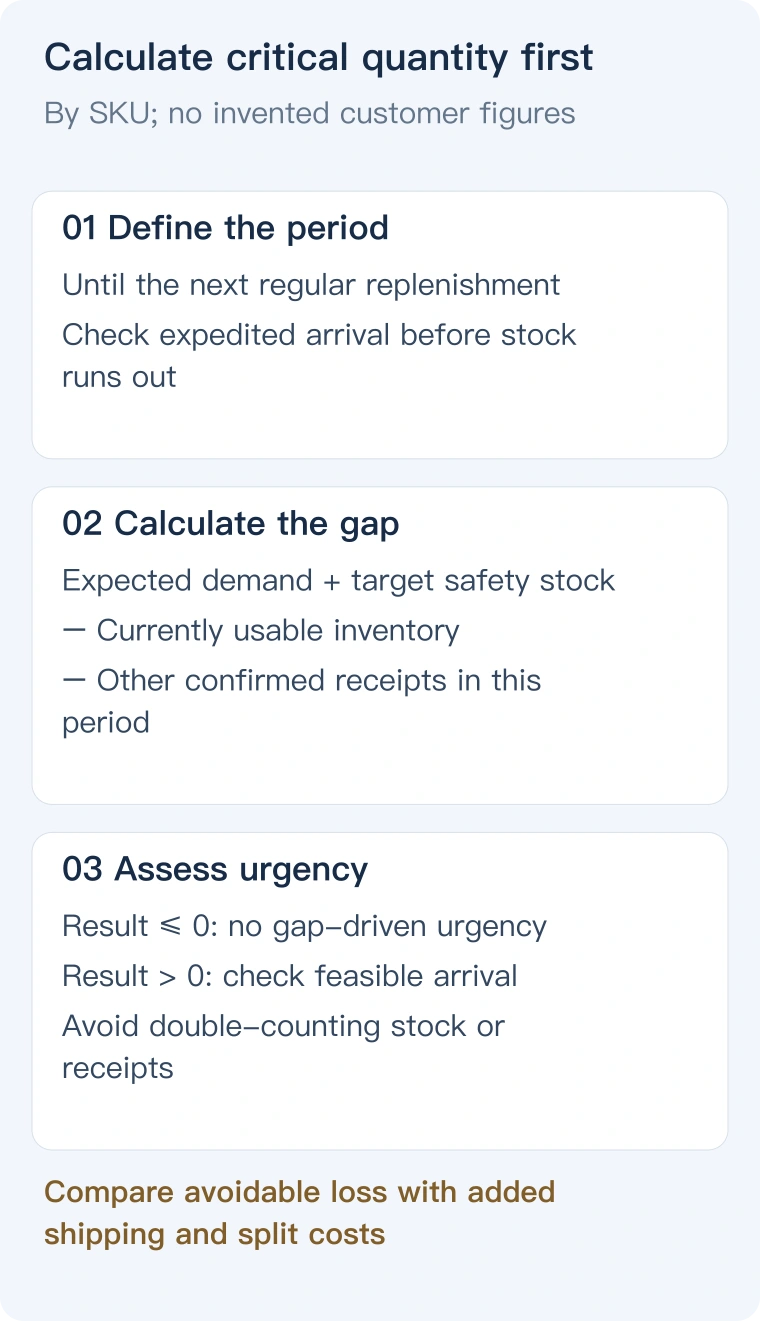
Where inventory and demand records are sufficiently complete, start with this calculation:
Critical replenishment quantity = expected demand before the next regular replenishment arrives + target safety stock − currently usable inventory − other confirmed receipts within that period.
If the result is zero or negative, that inventory gap alone normally does not justify expediting. Calculate by SKU and separately check that expedited goods can arrive before stock is exhausted. Sufficient total quantities do not rule out a temporary stock-out between receipt dates.
Use consistent definitions for forecast demand, allocated stock and goods already in transit to avoid counting or subtracting the same units twice. New products, promotions and project orders need explicit demand scenarios rather than an automatic application of historical daily sales.
The purpose is to identify the business exposure that an expedited service would protect, instead of upgrading an entire order merely because it is peak season.
Include the incremental cost of splitting an order
Split shipments are not automatically cheaper. They can add sorting, packaging, declarations, handling and repeated destination deliveries, as well as more receiving coordination.
Compare the avoidable cost of a stock-out or interruption with the additional transport and split-shipment costs. Estimate losses from actual orders or inventory evidence; total sales revenue is not the same as avoidable loss.
A small critical quantity affects near-term sales or production
Option worth comparing:Air freight for that quantity, with the remainder travelling separately
Conditions to verify first:Critical goods can be declared, received and used independently; the expedited plan meets the deadline.
Routine stock has a delivery buffer
Option worth comparing:Ocean or rail alongside an air alternative
Conditions to verify first:Bookable resources, end-to-end delivery time and total cost suit the order.
All goods must arrive and be used as a complete set
Option worth comparing:Complete-shipment alternatives first
Conditions to verify first:The full set is ready and can be accepted together within the receiving window.
Ocean, rail and air are not a fixed price ladder. Origins, destinations, shipment size, dimensions and delivery requirements can change the comparison. Use actual options with equivalent service scope.
Check the air quote and the complete delivery timeline
Provide the commodity, piece count, dimensions and weight of each package, collection location, destination postcode, cargo-ready date and latest receipt date. Disclose any specific cargo requirements accurately. “Several hundred kilograms to Europe” is rarely enough to assess a replenishment target.
For each air option, check the actual departure arrangement, direct or connecting service, cargo acceptance cut-off, chargeable weight, import clearance and final delivery. Flight time is not the elapsed time from collection at the supplier's warehouse to receipt by the customer.
During October, reassess critical quantities when the inventory gap changes or a planned flight or arrival cannot be confirmed. The useful adjustment is to the quantity requiring urgency, not simply a reaction to a broad price-rise or price-fall headline.
Common questions
Does higher air-cargo demand mean every European lane will become more expensive?
No. Monthly aggregate data cannot replace a quote for a specific airport pair and date. Check the origin, destination, direct or connecting arrangement and actual handover date separately.
When is split replenishment worthwhile?
When only part of the order is urgent, that part can be used and delivered independently, and the business value of earlier arrival exceeds the extra shipping and split costs. It is not the default solution for every order.
Why is actual weight alone insufficient?
Dimensions can affect chargeable weight and loading feasibility. Piece counts, package lengths, widths, heights and actual weights are needed to compare prices and acceptance. The applicable calculation must be confirmed for the selected service.
To assess Europe-bound replenishment, send the shipment details and distinguish the quantity that must arrive first from the quantity that can arrive later. This supports a mode comparison based on the real inventory gap.
Sources & editorial note
This article reflects the information and reporting period identified in its text. Source links, where available, are included in the article. Verify rates, transit times, customs rules and market figures against the latest carrier or official authority information before making a shipment decision.
Editorial review covers terminology, clarity and basic consistency. It is not legal, tax or customs advice and does not constitute a fixed quotation.
Planning a China-Europe shipment?
Share your origin, destination and cargo details for a shipment-specific assessment.
Request a freight quote