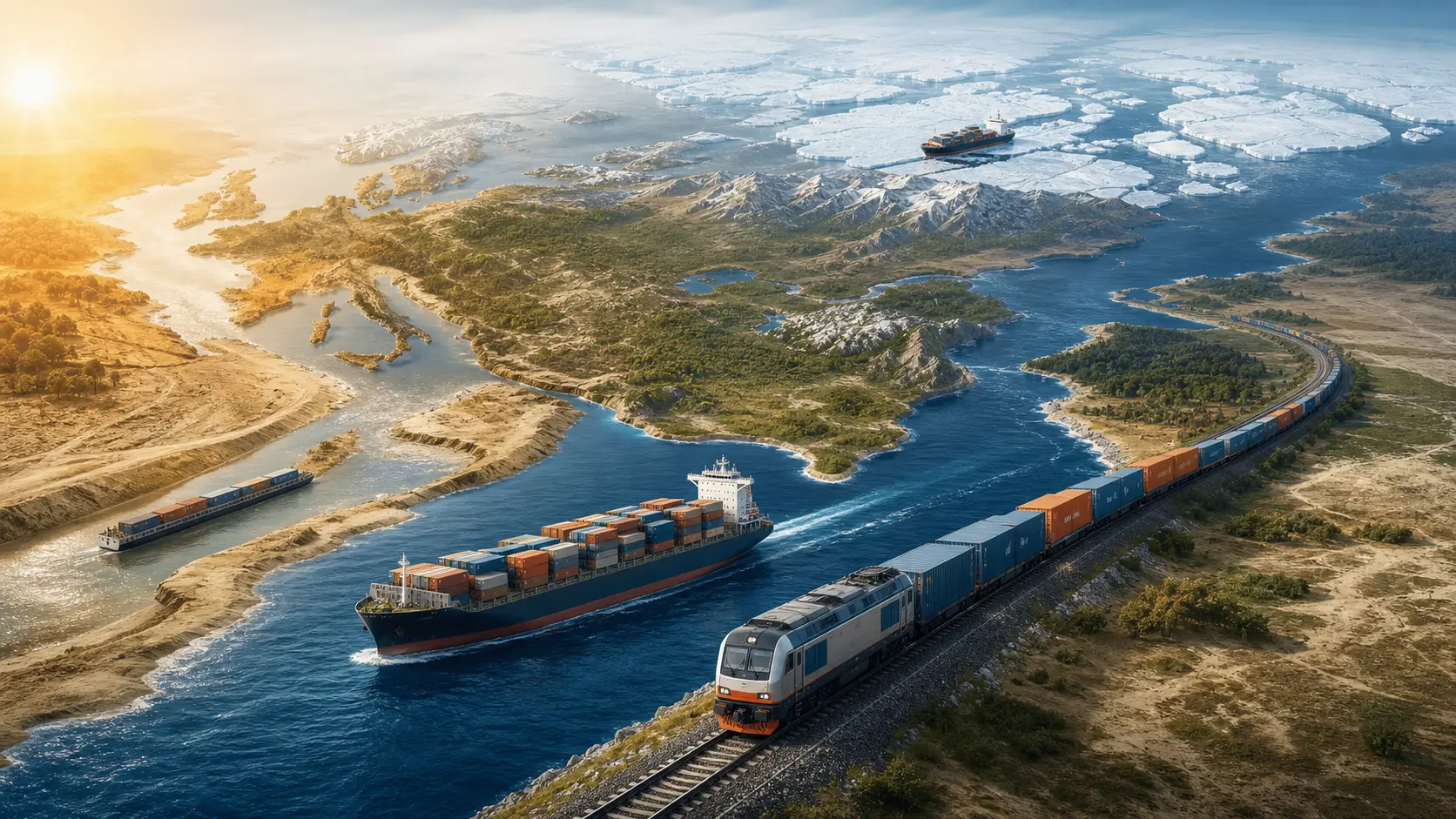
In the past, planning a China-Europe logistics solution usually came down to comparing three metrics: price, transit time and capacity. But recent market shifts show that heatwaves, drought, low water levels, ice conditions and geopolitical conflict are becoming decisive variables in choosing a transport route.
From air-conditioners and cooling products quickly riding China-Europe rail to low Rhine water levels disrupting European inland transport, to Arctic container routes moving from test voyages toward fixed-schedule trials, China-Europe logistics is entering a new phase: customers are no longer buying just a freight rate — they are buying the ability to deliver on time in an uncertain environment.
Heat Drives Urgent Demand, Making China-Europe Rail a Supply-Chain Response Tool
Since 2026, China-Europe trains departing from Xi'an have shipped over 34,000 air-conditioners, fans and other cooling products to 15 European countries to meet demand from European heatwaves.
From Xi'an, cargo reaches Europe by rail in roughly 12 days, while sea freight typically takes about 40 days. For ordinary stock goods, a near-month transit gap may be just a difference in shipping cycle; but for weather-sensitive seasonal goods, it can directly determine whether a company captures its sales window.
Air-conditioners and fans share three typical characteristics: demand is easily affected by weather changes; the peak selling season is relatively concentrated; and after the demand window passes, product value and sales efficiency can decline quickly.
This is why the value of China-Europe rail is not only that it is faster than sea freight, but that it can convert sudden demand into an executable supply-chain response. When a European heatwave persists and local inventory runs short, companies can restock quickly by rail. Compared with higher-cost air freight, China-Europe rail offers a more practical option between speed and cost.
This also means more high-value, seasonal and time-sensitive cargo may adopt a combined transport strategy in the future: base inventory positioned ahead by sea, with urgent restocking and peak-season top-up orders completed by rail.
Rhine Water Levels Recover, but European Inland Logistics Cannot Rebound in Step
When China-Europe cargo reaches a European port or rail terminal, the job is far from done. What truly shapes final delivery is often the capacity of the last few hundred kilometres inside Europe.
The Rhine is a vital European inland waterway connecting ports such as Rotterdam and Antwerp to the German, French and Swiss hinterland. Energy, chemical raw materials, industrial equipment and containerized goods all depend on this corridor to varying degrees.
This week, water levels at key Rhine points have recovered step by step from extreme lows, expected to exceed 70 centimetres by 24 August. But a recovering water level does not mean the transport market returns to normal immediately.
During low-water periods, barges must reduce load for safe navigation, with effective capacity at times falling to around a quarter of normal levels, while related transport costs still stand near four times July levels. Even as water rises, accumulated cargo, vessel scheduling and equipment turnaround all take time to absorb.
This exposes a problem in the China-Europe supply chain that is easy to overlook: the transport bottleneck does not necessarily occur at the Chinese origin end — it can also appear between the European port and the final warehouse.
When inland waterway transport is constrained, shippers try to shift cargo to rail or road, but switching between transport modes is not cost-free. Concentrated diversion over a short period can trigger a chain reaction, including tighter European rail capacity; shortages of trucks and drivers; slower turnaround of trailers, chassis and container equipment; rising storage pressure at ports and inland terminals; increased surcharges on last-mile transport; and fluctuation in final delivery times.
So when evaluating China-Europe transport, companies should not focus only on when cargo reaches a European port or rail terminal. They should also confirm the inland segment's carrier resources, transshipment capacity and alternative routes.
The Arctic Route Moves from One-Off Trials to Fixed-Schedule Testing
Beyond traditional sea freight and China-Europe rail, the Arctic route also entered a new commercial testing phase in 2026.
Sea Legend's China-Europe Arctic Express departed from Ningbo Zhoushan Port on 15 August. According to public plans, the 2026 Arctic navigation season will deploy 7 vessels on 8 voyages, with total capacity of around 15,700 TEU.
The route uses Felixstowe in the UK as its primary European gateway, covering or extending to Rotterdam, Hamburg, Antwerp and Gdansk. Planned transit from Ningbo to Felixstowe is about 20–22 days, targeting cross-border e-commerce products, batteries, energy-storage equipment and other time-sensitive cargo.
Compared with the single trial voyage of 2025, the 2026 change is not just more voyages; it begins to form relatively fixed departure times, defined vessel arrangements, concentrated Chinese origin ports, a clearly defined European coverage range and targeted cargo types.
This means the Arctic route is trying to move from technically navigable to commercially repeatable.
Still, the Arctic route does not yet have the conditions to replace the Suez route at scale. It is constrained by sea ice, weather, vessel seaworthiness, navigation permits, insurance costs and emergency-rescue capability, and its operating window is highly seasonal.
The Arctic route also faces ecological controversy. Black-carbon emissions, fuel-spill risk and the ability to respond in remote seas are all issues that must be addressed before it expands commercial operation.
A more accurate assessment: in the short term the Arctic route will not replace traditional sea freight, but it may become a supplementary corridor between specific seasons, specific cargo types and specific markets.
China-Europe Logistics Is Entering an Era of Climate-Risk Pricing
Air-conditioners riding China-Europe rail, low Rhine water limiting barge loading, and Arctic container routes starting fixed-schedule trials seem like three unrelated stories, but they point to the same trend: climate factors are steadily moving from occasional disruption to a normal variable in supply-chain planning.
In the past, companies might have only compared whether sea or rail was cheaper or faster. Now they must answer more questions: Could an extreme heatwave suddenly push up demand for a category? Could European river levels affect port-to-warehouse delivery? Could the geopolitical situation in the Red Sea and beyond change traditional sea-freight timing? Could the Arctic navigation window offer a seasonal alternative? If one corridor is blocked, can cargo switch in time to rail, road or another port? And can the cost and time of switching routes be estimated in advance?
In this environment, the core competitiveness of a logistics product is no longer the lowest quote, but the ability to convert external risk into a relatively predictable delivery time.
Managing climate risk here is not traditional insurance underwriting. It means reducing the impact of weather and geopolitical events on actual delivery through multi-corridor design, node monitoring and backup capacity arrangements.
The Future Is Not One Mode Replacing Another
Sea, rail, road, inland waterway and the Arctic route are not simply substitutes; they suit different cargo and delivery scenarios.
Traditional sea freight: large-scale base transport. Traditional sea freight still offers large capacity, mature networks and relatively low unit cost, suited to ordinary goods with flexible lead times, larger volumes and the ability to stock ahead.
China-Europe rail: serving time-sensitive cargo. Rail suits high-value, strongly seasonal and tightly scheduled goods, and can also be used for urgent restocking after sea-freight delays. Air-conditioners, fans, new-energy vehicles, lithium batteries and high-end manufacturing equipment are representative categories.
Arctic route: validating seasonal express value. For now the Arctic route is better treated as a commercial test product. Its potential value lies in shortening maritime distance from China to some Northern European ports, but companies must fully assess ice conditions, insurance, compliance and schedule stability.
European inland intermodal: deciding final delivery quality. After cargo reaches Europe, carriers and shippers must dynamically choose between inland waterway, rail and trucking based on port congestion, Rhine water levels, rail capacity and road resources. For many companies, this segment is what actually determines final arrival time.
How Foreign-Trade Companies Can Adjust Their China-Europe Logistics Strategy
Facing a market where climate and geopolitical risk are intertwined, companies can optimize their transport arrangements from several angles.
1. Divide transport modes by product value and sales window. Do not choose a route on transport cost alone; weigh cargo value, lead time and the loss of missing a sales window. Ordinary inventory can use sea freight; urgent restocking and peak-season top-up orders can use rail; and for time-sensitive cargo with the right conditions, watch seasonal products such as the Arctic route.
2. Plan the European inland segment in advance. When booking, do not confirm only the delivered-port price or terminal-to-terminal price. Also confirm the transport arrangement from the destination port to the warehouse, including rail schedules, truck resources, barge capacity and alternative paths.
3. Set up backup corridors for critical orders. For orders where the cost of delivery default is high, plan at least two transport options — for example, sea as the primary choice with China-Europe rail as backup; barge as primary with rail or truck as backup; splitting a single gateway port into multiple ports; or base inventory by sea with urgent orders topped up by rail.
4. Bring weather and infrastructure data into transport decisions. Companies should follow not only spot rates, but also indicators such as European heatwaves, Rhine water levels, port congestion, rail-terminal load, border transshipment efficiency and Arctic ice conditions. This information is increasingly the key basis for judging delivery risk.
5. Compare total delivered cost, not a single freight rate. A cheaper route can end up costing more if it brings longer delays, extra warehousing, transshipment surcharges or a missed selling season. Companies should evaluate transport fees, inventory holding, delay risk, order default and lost market opportunity together.
Certainty Will Become the Most Important Product in China-Europe Logistics
This week's China-Europe logistics market sends a clear signal: the future competition is not about sea freight or rail replacing each other, nor about one new route transforming global trade. It is about who can offer more switchable, trackable and predictable transport options.
Ordinary cargo continues to move at scale by traditional sea freight; time-sensitive cargo is delivered quickly by China-Europe rail; the Arctic route explores the commercial space of seasonal express shipping; and the European inland segment switches dynamically among rail, road and inland waterway based on water levels, capacity and congestion.
As heatwaves, drought, ice conditions and geopolitical conflict gradually become long-term supply-chain variables, customers will ultimately buy not just a slot or a rate card, but a logistics solution that can guarantee delivery in an uncertain environment.