Author: Sino-Euro Logistics Editorial Team
Reviewed by: Sino-Euro Logistics Editorial Team
Published: 2026-10-02
Last reviewed: 2026-10-02

Hero image: AI-generated concept illustration, not an operational photograph or evidence of a specific route or company capability.
Information checked through 2 October 2026 | Industry news · Ocean freight
Lower China–Europe ocean rates can improve purchasing conditions, but they do not remove delivery risk. For an order with a firm receipt deadline, the useful question is not whether the market has reached its lowest price. It is whether the quotation, specific sailing and destination delivery plan work together: can the cargo catch that vessel, can the container be released and collected after arrival, and can the consignee receive it on time?
Two reports, two observation periods
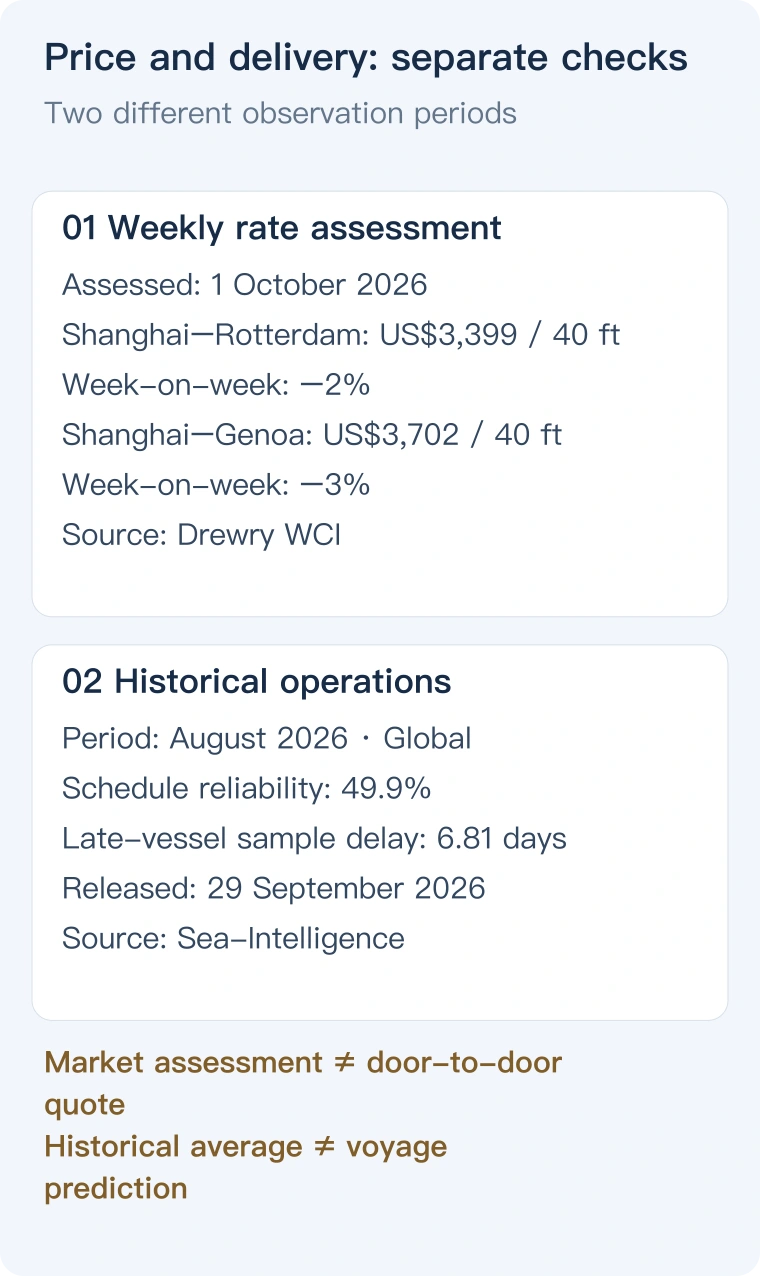
Drewry's 1 October assessment put Shanghai–Rotterdam at US$3,399 per 40-foot container, down 2% week on week, and Shanghai–Genoa at US$3,702, down 3%. These are market assessments for specified lanes, not executable door-to-door offers for an individual shipment. Source: Drewry World Container Index, 1 October 2026
A separate Sea-Intelligence report published on 29 September describes historical operations. Global schedule reliability in August 2026 was 49.9%; vessels in the late-arrival sample had an average delay of 6.81 days. This is neither a live October Europe-lane reading nor a buffer that should automatically be added to every shipment. Source: Sea-Intelligence, 29 September 2026
Together, the reports support checking price and delivery risk separately. They do not establish that every Europe-bound service is delayed, or that Shanghai or Ningbo is currently experiencing a port shutdown.
Compare options against the same delivery target
A lower quote is useful only if it meets the order's requirements. Two offers labelled “China to Germany” may involve different departures, direct or transshipment services, container collection conditions and inland delivery arrangements. Comparing their ocean-freight line alone can be misleading.
Set three common inputs before comparing: the same cargo-ready date, the same delivery address and the same latest acceptable receipt date. Then confirm the vessel and voyage, estimated departure and arrival, quotation validity, and responsibility for customs clearance and final delivery. Port arrival is not warehouse receipt: document readiness, release, collection and unloading appointments all belong in the plan.
Waiting another week may reduce the transport purchase price, but it can also consume the time available to absorb exceptions. If that margin disappears, part of the shipment may need a more expensive expedited option.
Booking decisions for three order types
Flexible deadline and enough stock to cover demand
First question:Does waiting still leave a workable delivery margin?
Practical action:Compare adjacent sailings and valid quotes; set a latest booking date.
Only a few SKUs face an imminent stock-out
First question:Can the critical quantity travel separately?
Practical action:Price urgent replenishment and routine stock separately, including the extra cost of splitting the order.
Fixed contractual deadline with material delay costs
First question:Can the ocean option meet the receipt requirement?
Practical action:Check executable ocean, rail or air alternatives rather than relying on advertised transit times.
These are decision rules, not a blanket recommendation to reroute. Rail and air also depend on available capacity, cargo acceptance, clearance and final delivery. The appropriate alternative depends on the actual goods and the booking conditions at the time.
October pricing: distinguish an increase attempt from a confirmed offer
Drewry's 1 October commentary also noted carriers' attempts to raise freight-all-kinds (FAK) rates in the second half of October, with implementation still uncertain. A proposed increase is not the same as an achievable transaction price. Source: Drewry market commentary
Our assessment is that recent easing creates room to negotiate, but does not establish a month-long downward trend. In the second half of October, check whether announced increases actually appear in valid offers and whether the relevant sailing can be confirmed. An announcement alone is not a reason to reserve speculative capacity.
Turn that assessment into an operational rule: decide how long the order can wait. If a sailing can no longer meet the required receipt date, compare alternatives immediately instead of continuing to wait for a lower price that may not materialise. The firmer the deadline, the earlier an executable plan should be confirmed.
Common questions
Does a falling index mean my actual quote will fall by the same amount?
No. An index describes a particular sample and observation date. Your quote also depends on origin and destination ports, container type, sailing date, cargo and scope of service. Compare valid offers on the same basis; do not substitute an index value for a door-to-door budget.
Can I simply add 6.81 days to the transit time?
No. That figure is the August average for late vessels globally, not a forecast for your voyage. Choose a delivery margin using the selected service's recent performance, transshipment exposure, import release requirements and destination appointments.
Should an uncertain ocean shipment move entirely to rail or air?
Not necessarily. Identify the quantity that cannot wait, then compare confirmed alternatives. Expediting only critical goods may be appropriate; however, extra declarations, split handling and multiple deliveries can sometimes make a complete-shipment option more practical.
For a shipment with a fixed deadline, request a shipment-specific assessment with the origin, destination postcode, cargo-ready date, pieces, weights, dimensions and latest receipt date. For the wider cost comparison, see why lower ocean rates do not necessarily reduce the total logistics cost.
Sources & editorial note
This article reflects the information and reporting period identified in its text. Source links, where available, are included in the article. Verify rates, transit times, customs rules and market figures against the latest carrier or official authority information before making a shipment decision.
Editorial review covers terminology, clarity and basic consistency. It is not legal, tax or customs advice and does not constitute a fixed quotation.
Planning a China-Europe shipment?
Share your origin, destination and cargo details for a shipment-specific assessment.
Request a freight quote