Author: Sino-Euro Logistics Editorial Team
Reviewed by: Sino-Euro Logistics Editorial Team
Published: 2026-08-08
Last reviewed: 2026-08-08
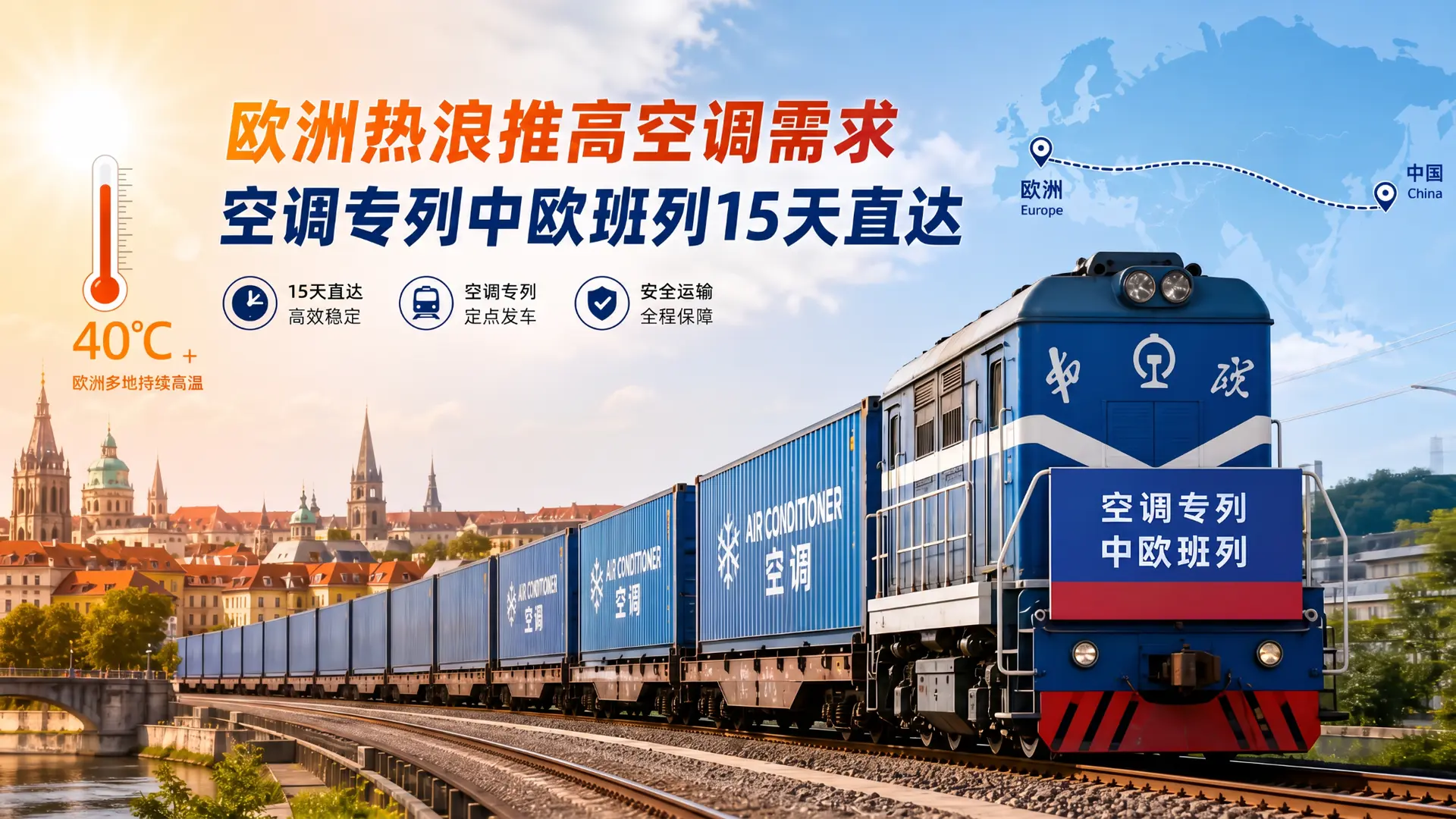
As European temperatures surpassed 40°C, Chinese AC makers shipped via China-Europe rail, cutting transit from ~40 days by sea to ~15 days by rail.
Seasonal demand changes the transport calculation
The August 2026 Chinese article described demand for cooling equipment during European temperatures above 40°C, with Chinese manufacturers including Midea and Gree responding to seasonal orders. In that setting, late delivery can mean missing a substantial part of the selling season, even when the freight itself is inexpensive.
Understanding the 15-day comparison
The original report compared an approximately 15-day rail movement with around 40 days by sea, a difference of roughly 25 days in that example. These are historical, indicative figures—not a guaranteed door-to-door service standard. Collection, cargo acceptance, departure availability, border transfers, customs clearance and the final delivery appointment all affect the actual lead time.
Rail can offer a middle ground between lower-cost ocean freight and more expensive air freight when a seasonal shipment cannot wait for the next suitable vessel. Routing and acceptance must be confirmed for the particular departure; a published transit example does not mean that every origin, destination or commodity has the same service.
Plan seasonal inventory before the peak
Assess the goods against the latest required arrival date and the cost of an inventory shortage. It may be better to send a smaller replenishment quantity by rail while retaining the main volume by sea. Where demand is uncertain, smaller, more frequent replenishments can reduce the risk of arriving after the seasonal peak.
Allow time for booking, collection and documentation. The original article suggested seeking space one to two weeks ahead, but actual cut-offs and equipment availability take precedence. Confirm the complete chain rather than relying on the advertised main-line transit time alone.
Cargo acceptance and appliance handling
Air conditioners need packaging suitable for repeated handling, moisture protection and the agreed transport route. Refrigerant type, quantity and equipment specifications can affect transport classification and acceptance. Do not assume every refrigerant-containing appliance can be declared as ordinary cargo: obtain the relevant technical information and check the applicable rules and carrier requirements for the shipment.
The service assessment can cover collection in China, an appropriate rail departure, customs coordination and onward delivery in Europe. The original article discussed origins such as Xi'an, Chengdu, Zhengzhou and Yiwu and destinations including Małaszewicze, Duisburg, Hamburg and Budapest. Availability must be reconfirmed when booking.
Which option should the shipper choose?
Rail may be appropriate when its full delivery plan fits the sales window and its additional cost is lower than the expected loss from a stockout. Air freight is usually reserved for the most urgent portion; sea freight remains an option where inventory provides sufficient time. Request a shipment-specific comparison covering all charges and delivery milestones.
Source context
This English expansion follows the August 2026 Chinese article, which referred to Railway PRO, Table.Briefings and China Railway reporting. Its market examples and transit figures describe that reporting period; they are not a live quotation or a promise of current capacity.
Sources & editorial note
This article reflects the information and reporting period identified in its text. Source links, where available, are included in the article. Verify rates, transit times, customs rules and market figures against the latest carrier or official authority information before making a shipment decision.
Editorial review covers terminology, clarity and basic consistency. It is not legal, tax or customs advice and does not constitute a fixed quotation.
Planning a China-Europe shipment?
Share your origin, destination and cargo details for a shipment-specific assessment.
Request a freight quote