Author: Sino-Euro Logistics Editorial Team
Reviewed by: Sino-Euro Logistics Editorial Team
Published: 2026-10-02
Last reviewed: 2026-10-02

Hero image: AI-generated concept illustration, not an operational photograph or evidence of a specific route or company capability.
Market analysis · Opinion | Information cut-off: 2 October 2026 | Outlook: 3 October–2 November 2026
The more useful risk to watch over the next month is not a simultaneous price rise across every mode. It is a widening gap between market averages and the delivery conditions of an individual order. Based on the available ocean-rate, air-cargo, European infrastructure and economic evidence, our baseline is continued pressure on ocean prices, air freight focused on defined replenishment gaps, and rail assessed by its actual route and European delivery arrangements. No single mode should be treated as the answer for the whole month.
That baseline assumes no significant new disruption to shipping lanes, widespread transport restrictions or exceptional demand shock. The following sections distinguish published facts from analysis. They are not unconfirmed price or arrival promises.
Four signals supported by published evidence
Ocean prices weakened, while historical reliability still warrants attention. Drewry's 1 October assessments for Shanghai–Rotterdam and Shanghai–Genoa fell 2% and 3% week on week. Sea-Intelligence's 29 September release put August global schedule reliability at 49.9%. The first is a recent price observation; the second is a lagging operational statistic. They cannot be combined into a live October delay forecast. Drewry; Sea-Intelligence
Air-cargo demand has support, but aggregate figures do not establish lane availability. IATA's August figures, released on 29 September, showed global demand up 4.4% year on year and available capacity down 0.1%. Jet-fuel prices increased 8.3% month on month. Demand and cost deserve monitoring, but those observations do not establish a universal China–Europe air-rate increase in October. IATA
More terminal capacity is not the same as faster end-to-end delivery. On 1 October, METRANS announced completion of the expansion of its Poznań terminal. A European Commission ERTMS study announced the same day identified persistent fragmentation in rail-technology deployment. One concerns a specific node; the other longer-term system coordination. Neither establishes that all China–Europe rail shipments have become faster. METRANS; European Commission
Cost pressure and cautious purchasing can coexist. Istat's preliminary September figures, released on 30 September, put Italian consumer-price inflation at 4.2% year on year, compared with 3.3% in August. Its September survey showed lower consumer and composite business confidence. Istat notes that changes to the consumer survey's collection network partly affected the measured movement; an adjusted reading still indicated a moderate decline in overall consumer confidence. Manufacturing confidence improved even as the composite business measure fell. These are Italian signals, not evidence for every European country, and consumer prices are not a freight-rate index. Istat prices; Istat confidence
Assessing ocean, air and rail over the next month
Our ocean baseline allows for further negotiating room, but not unlimited access to low-priced space for any departure week, port or service combination. Falling averages can coexist with tighter individual sailings. Capacity changes or concentrated delivery dates can affect bookability even without a clear recovery in overall demand.
Drewry has already described carriers' attempts to raise FAK rates in the second half of October, with implementation uncertain. We therefore consider attempted increases and diverging transaction prices across sailings more plausible than an immediate, demand-led rise everywhere. This is an analytical judgment with moderate confidence, not a carrier quotation. Drewry's 1 October commentary
If comparable Europe-lane indices rise in two consecutive releases and actual offers and capacity feedback tighten at the same time, weaken the assumption that waiting will secure a lower price. This is a proposed observation rule, not a statistically validated turning-point model.
For air freight, current evidence is insufficient to support a blanket October price-decline forecast. Differences between demand and capacity, fuel costs, destinations and cargo-ready dates matter. Confirm resources for the quantity that must arrive on time, instead of automatically upgrading all routine stock.
For rail, uncertain ocean delivery may encourage some customers to compare alternatives, but there is insufficient evidence to predict a uniform rise in industry-wide volumes or prices. A terminal expansion matters to an order only when a suitable departure, customs process and European delivery connection are confirmed. Road and final-mile arrangements also need country- and route-specific checks; conditions at one border do not establish a Europe-wide trend.
How geopolitical developments can affect a shipment
The operational question is whether a political development changes executable trading or transport conditions, not simply whether it generates a prominent headline.
Watch three separate mechanisms: changes to waterways or airspace that cause carriers to adjust services; energy-price changes entering fuel or related charges; and sanctions or trade measures changing requirements for a party, product or route. Verify each mechanism rather than using “tensions” to explain every cost or delay.
For example, the Council of the EU's 28 September announcement added targeted sanctions against specific individuals and entities. It supports continued counterparty screening; it is not a blanket China–Europe rail ban and cannot by itself determine whether an individual shipment may proceed. Check the rules in force and the actual transaction details when making that assessment. Council of the EU, 28 September 2026
Economically, our working hypothesis is that some European buyers will emphasise inventory turnover and phased delivery rather than simply expanding stock. Cost pressure and weaker confidence support this hypothesis more strongly for Italy than for Europe as a whole. Direct evidence of stronger customer orders, sales or replenishment should override it.
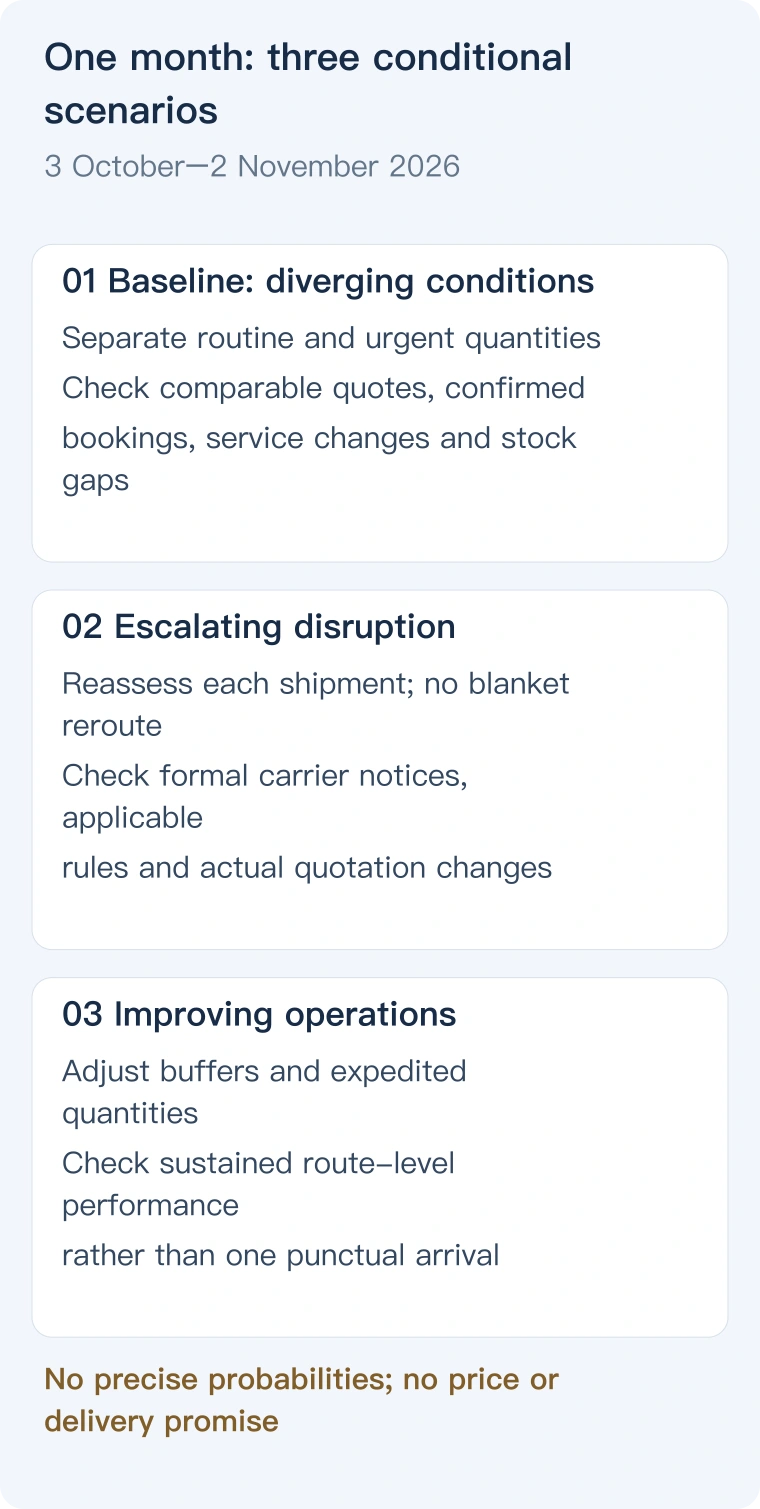
Three scenarios and the evidence that would change the view
Baseline: price and delivery diverge
Conditional development:Ocean retains negotiating room while some sailings or air options tighten; rail varies by route.
Business response:Confirm routine transport, compare urgency for critical goods separately and retain an appropriate delivery margin.
Evidence to check:Comparable quotations, booking confirmations, service adjustments and actual inventory gaps.
Disruption escalates
Conditional development:A new waterway, airspace or energy shock changes routings, charges or connections.
Business response:Recheck valid offers and routes shipment by shipment; prioritise firm deadlines rather than rerouting everything.
Evidence to check:Formal carrier notices, applicable rules and actual price changes—not unverified social posts.
Operations improve
Conditional development:More reliable services and available capacity ease some delivery pressure, if demand does not strengthen materially.
Business response:Adjust buffers and expedited quantities when supported by evidence.
Evidence to check:Sustained improvement in the relevant route's actual delivery record, not a single punctual arrival or a verbal expectation.
No numerical probabilities are assigned: the public evidence does not support precise odds. The scenarios define what to observe and when to revise a plan; they are not statements that these events will occur.
Three working lists for the coming month
Orders: sort by latest acceptable receipt date. Separate quantities that cannot be late from routine stock and identify real inventory gaps. Peak-season or political headlines alone are not a reason to expedite an order with no demonstrated gap.
Transport options: for critical orders, keep the current executable plan and one feasible alternative. Record the cargo-ready date, quote expiry, transport milestones, import-document readiness and final delivery appointment. An alternative must fit the real cargo, not merely trace another line on a map.
Weekly review: check actual orders, comparable offers and transport execution together. If prices fall but the delivery margin disappears, address delivery first. If prices rise but the order is not urgent, immediate whole-order expediting may be unnecessary. Do not wait for the next weekly meeting once the selected option no longer meets the receipt target.
Common questions
Should I wait for ocean rates to fall further before shipping?
Only if the remaining time still permits delivery and inventory covers demand. The relevant measure is how long the order can safely wait, not a guess at the index's lowest point.
Should every ocean shipment switch to rail now?
No. Verify bookable resources, cargo suitability, customs arrangements and European delivery. A change is justified only when the specific alternative better fits the deadline and budget.
Which new information should change this assessment first?
Start with carrier notices and delivery changes directly affecting the shipment, then consistent price and capacity feedback, and finally the wider macro direction. Revise the plan when order and execution evidence contradict the assumptions here.
To turn a market assessment into an order-level plan, share your cargo-ready date, quantity, destination and latest receipt date, distinguishing routine stock from critical replenishment.
This outlook covers 3 October–2 November 2026. After that window it should be read as historical analysis, not as a current market forecast.
Related analysis
October ocean rates and schedule reliability
Sources & editorial note
This article reflects the information and reporting period identified in its text. Source links, where available, are included in the article. Verify rates, transit times, customs rules and market figures against the latest carrier or official authority information before making a shipment decision.
Editorial review covers terminology, clarity and basic consistency. It is not legal, tax or customs advice and does not constitute a fixed quotation.
Planning a China-Europe shipment?
Share your origin, destination and cargo details for a shipment-specific assessment.
Request a freight quote