
The Europe-bound ocean freight market has recently sent seemingly conflicting signals. Weekly freight-rate assessments rose in late October, while a subsequent shipping-market analysis warned that softer demand and released capacity could put pressure on the market. For businesses planning to ship from China to Europe in November, the practical question is not how to turn these reports into a single price curve. It is whether the sailing week, origin and destination ports, available space and full cost work for the shipment.
Among the sources available as of 28 October 2026, Drewry and Xeneta provide spot-market rate assessments for different geographic scopes and dates. Linerlytica's 27 October report offers a market observation and its assessment of subsequent supply and demand. Each helps identify risks, but they are not interchangeable and none is a quote from our company.
Two weekly assessments rose, but their coverage differs
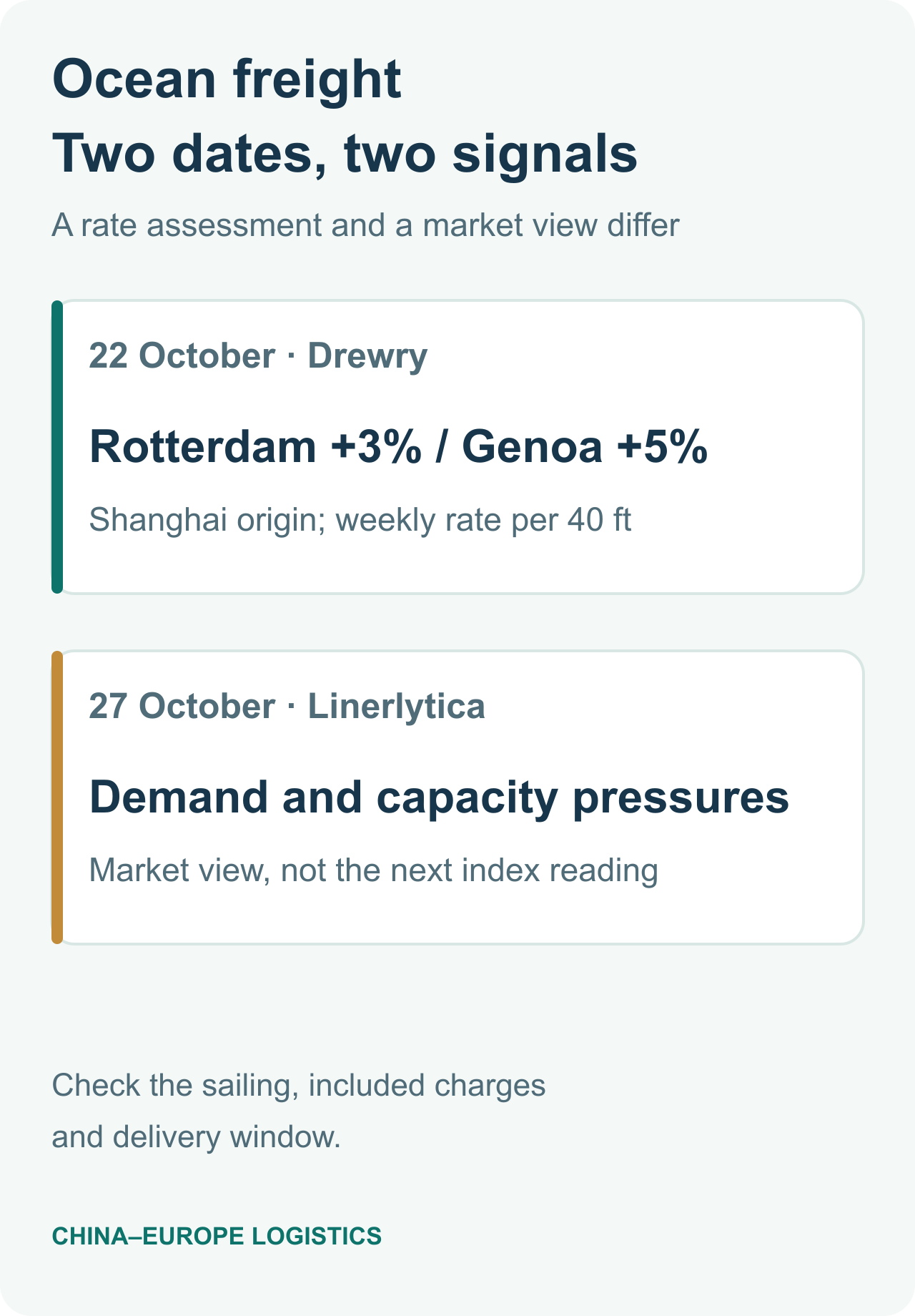
In its World Container Index assessment for 22 October 2026, Drewry put Shanghai–Rotterdam at USD 3,632 per 40-foot container, up 3% from the previous week. Shanghai–Genoa was USD 4,152 per 40-foot container, up 5%. These figures refer to individual port pairs and are Drewry's spot-rate assessments for that date, not a single rate for every China–Europe service.
In its weekly ocean freight update published on 23 October, Xeneta reported an average spot rate of USD 3,698 per forty-foot equivalent unit (FEU) from the Far East to North Europe, up 6.8% from 16 October. The Far East–Mediterranean average was USD 4,442 per FEU, up 5.8%. Far East, North Europe and Mediterranean describe regional trades; they are not the same as Drewry's Shanghai-to-specific-port assessments.
Both providers recorded weekly increases within their respective coverage, but their dates, geographic scopes and assessment methods differ. One figure cannot be treated as the next day's reading of the other, and the difference between them is not a price change. Neither assessment is a confirmed quote for an individual shipment or a door-to-door total.
Why does the later market observation point to pressure?
In its Week 43 market update, published on 27 October, Linerlytica said demand was softening into the traditionally quieter winter season and that vessels returning to the Suez route were releasing capacity, putting pressure on rates. It also said carriers had encountered difficulty pushing through planned November increases. This is the firm's market observation and judgment, not the next reading in either of the earlier rate series; it does not establish that rates have fallen on every European trade.
The report also distinguished between the Mediterranean and North Europe. It said that on the Far East–Mediterranean trade, some vessels had been released as services returned to the Suez route and had been redeployed to other markets. For the Far East–North Europe trade, it expected the effect of vessel releases on deployed capacity to become more apparent only in December. That was an expectation at the time, not a carrier's confirmed sailing or space commitment.
Xeneta, meanwhile, attributed part of the resilience in Europe-bound rates to demand in its 23 October update. Drewry focused on blank sailings and available capacity in its 22 October assessment and expected rates to rise slightly the following week. These explanations and expectations emphasise different factors; supply and demand can change at the same time, and none establishes a shared conclusion for the whole of November.
Why port waiting times, capacity and quotes are not the same thing
In its 22 October assessment, Drewry said vessel waiting time at Shanghai had fallen from 97 hours in Week 38 to 38 hours in Week 42. The same assessment reported two announced blank sailings on the Asia–Europe trade that week and eight for the following week. The first compares port waiting times in different statistical weeks; the second refers to blank sailings announced at the time for two different weeks. Neither is a live port reading for 28 October, and neither can be converted directly into a price for a particular sailing.
Shorter port waits can improve vessel turnaround, but capacity on a particular trade is also affected by service schedules, blank sailings, vessel deployment and cargo volumes. Even if overall supply changes, a particular port pair, container type or shipping week may behave differently. Market assessments can inform a budget, but the decision still depends on a valid quote and a specific sailing schedule.
What should shippers check before booking for November?
The following is our business analysis based on the information above, not a joint November price forecast by the three providers. If a customer has a tight delivery window, waiting for a lower price may create a risk of missing the customs cut-off or having to change sailings. If cargo readiness and the receiving window allow more flexibility, comparing valid options across shipping weeks may help balance cost and delivery requirements. Whether waiting is practical depends on the order and available capacity, not a market headline.
For each option, check:
- Cargo and dates: The goods description, packaging, container type or cargo volume, expected cargo-ready date and the customer's acceptable receiving window.
- Sailing and space: The actual ports of loading and discharge, expected schedule, documentation and customs cut-offs. Confirm whether space is still available on the sailing covered by the quote, and the change or cancellation terms after booking confirmation.
- Scope of the quote: Check validity, currency, ocean freight and listed surcharges. Establish which origin, destination and inland charges are included and which are extra; compare offers on the same service scope.
- Destination handover: Confirm who is responsible for release at destination, customs clearance, container collection or deconsolidation, delivery and receiving appointments. Check applicable free time, when charging starts and potential detention, demurrage and other charges.
A lower quote without an executable sailing, or one that excludes destination and inland costs included in another offer, cannot be compared on the headline number alone. After booking, continue to follow the sailing and handover status. Specific arrangements remain subject to confirmation by the carrier and relevant operators and to applicable terms.
Frequently asked questions
Does a carrier's rate-increase notice mean actual transaction prices have risen?
Not necessarily. A carrier notice sets out its pricing arrangements, while a market index is a research provider's assessment of a particular scope. An actual quote also depends on the port pair, container type, shipping date, surcharges and available capacity. Check the notice's applicability and whether the quote has been confirmed; the two are not the same price.
Do the increases recorded on 22 and 23 October mean rates will keep rising in November?
No. Drewry and Xeneta reported weekly assessments for their respective dates and coverage; those readings do not guarantee the later trend. Linerlytica flagged supply-and-demand pressure on 27 October, but its observation does not prove that every Europe-bound rate will fall either. Continue to check quotes, schedules and space for the sailing you need.
If waiting times at Shanghai fall, will Europe-bound ocean freight rates fall too?
Not necessarily. Drewry's waiting-time comparison concerned Weeks 38 and 42. Port turnaround is only one supply factor; actual rates also depend on trade capacity, cargo volumes, blank sailings and shipment-specific terms. A waiting-time change cannot be directly converted into a freight-rate change.
How should I compare two China–Europe ocean freight quotes?
Start with the same origin and destination, container type or cargo volume, shipping week and service scope. Then check validity, individual charges, available space, free time and responsibility for destination handover. Market assessments provide context; they do not replace an item-by-item comparison of the actual quotes.
To assess a specific shipment, prepare the origin, destination and postcode, goods description, number of packages, weight and volume, cargo-ready date, latest receiving date and required service scope. Quotes and schedules can then be compared against the capacity actually available.
Sources: Drewry assessment, 22 October 2026; Xeneta weekly update, 23 October 2026; Linerlytica public market update, 27 October 2026. Drewry's page is updated over time, so retain the original assessment date when citing its figures. This article uses information available as of 28 October 2026; later market conditions and individual sailings require fresh confirmation.
Review our ocean freight service scope or send shipment details through the enquiry page.